The Oldest Limit
Long before the Supreme Court told Washington it could not commandeer the states, it told Georgia it could not reach inside Cherokee land.

In 1831, a missionary named Samuel Worcester was sentenced to four years of hard labor. His crime was living in Cherokee territory without a license from the State of Georgia. Georgia had decided that its laws ran everywhere inside the lines on its map, Cherokee land included, and it meant to prove it.
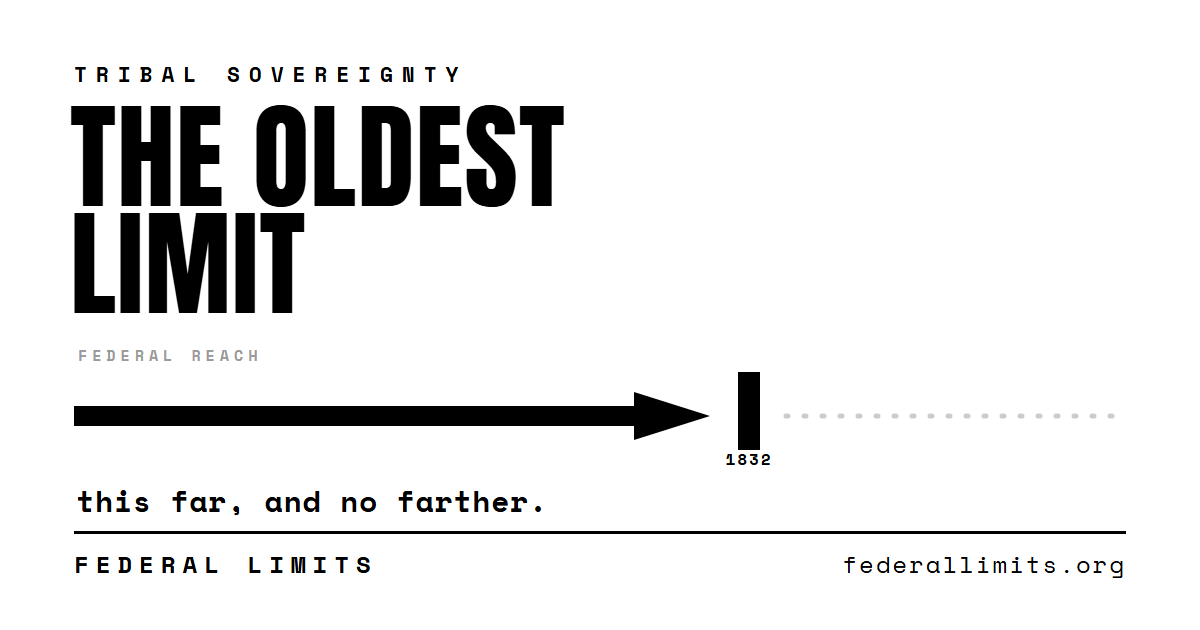
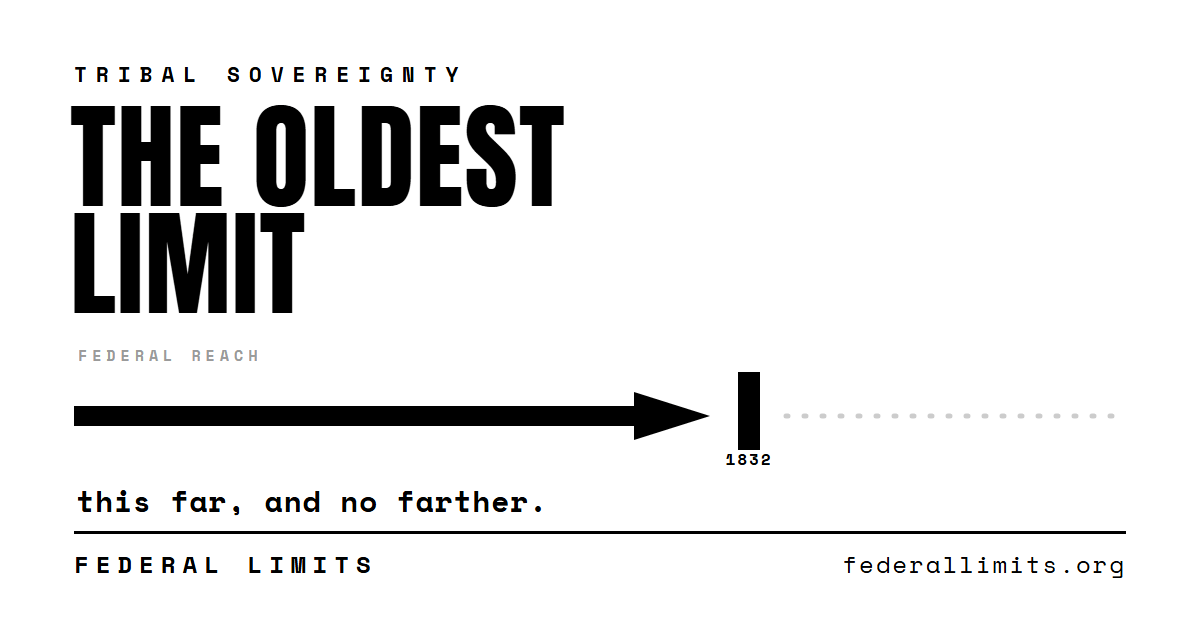
The Supreme Court disagreed. In Worcester v. Georgia (1832), Chief Justice John Marshall described the Cherokee Nation as “a distinct community occupying its own territory” — one in which, he held, the laws of Georgia “can have no force.” It was one of the earliest times an American court looked at a government insisting its power had no edges and answered, plainly: this far, and no farther.
That holding is the whole story of this project, told almost two hundred years before we existed. The limits we track today — the places where the law tells federal power where it has to stop — are not a modern invention. The oldest and hardest-won of them was drawn by tribal nations, and the fight to keep it drawn has never really ended.
The first line, and the third sovereign
To understand why a state could not reach inside Cherokee land, start with what tribal nations were — and are. They are not creations of the federal government. Their authority did not come from the founding charter; it predated it. The nations were here, governing themselves, before there was a Washington to answer to.
The founders knew it, and they wrote it down. The clause giving Congress power to regulate commerce “with the Indian Tribes” lists them right alongside foreign nations and the several states — a category of their own. In Cherokee Nation v. Georgia (1831), Marshall gave that category its enduring name: tribes were “domestic dependent nations,” in a relationship to the United States that “resembles that of a ward to his guardian.” Earlier reasoning had already established that the federal government, not the states, was the only party that could deal with tribes at all — a doctrine built on troubling premises about European “discovery,” but with one durable structural effect: from the very beginning, individual states were cut out of the relationship entirely.
So when Georgia tried to swallow Cherokee territory, it was not merely overreaching against the Cherokee. It was claiming a power the founding design had never handed it. Worcester said so. The line it recognized was not a gift to the Cherokee Nation. It was an acknowledgment of a sovereignty that was already there — the original “third sovereign,” neither foreign country nor state.
A line on paper is not a line held
Here is the part no honest account can skip. Worcester was a victory on paper that the country refused to honor in fact. Within a few years, federal and state power did to the Cherokee precisely what the Court had said they could not: in 1838, the Cherokee Nation was driven west along what is remembered as the Trail of Tears, and thousands died on the way. The line had been drawn by the highest court in the land. It was crossed anyway.
What followed over the next century was a slower erasure. The Dawes Act of 1887 broke up communally held tribal land into individual parcels and opened the remainder to outsiders; by 1934, the tribal land base had fallen from roughly 138 million acres to about 48 million — some 90 million acres gone. Then, in 1953, Congress resolved to end the relationship altogether. The policy was called “termination”: around a hundred tribes had their standing as nations formally dissolved, their lands sold, their people pushed to relocate to cities. A companion law handed several states criminal and civil authority over tribal land that had been off-limits to them since Worcester.
If a court ruling were self-enforcing, none of this could have happened. That is the central, uncomfortable lesson of the entire story: a limit on government power is only ever as real as the will to defend it. Written down and then abandoned, it is just words on a page.
The refusal
And yet the line came back — because the nations refused to let it stay erased.
The reversal did not arrive on the government’s conscience. It was forced — by decades of litigation, organizing, and political insistence from Native nations and activists who would not accept that their sovereignty had been legislated out of existence. In 1934, the Indian Reorganization Act halted allotment and began returning land. By 1970, the official position had swung hard enough that a sitting president, Richard Nixon, called termination “morally and legally unacceptable” and asked Congress to bury it. Five years later, the Indian Self-Determination and Education Assistance Act — signed by President Gerald Ford in January 1975 — gave tribal governments the authority to run their own programs in health, education, and housing that federal agencies had administered over their heads for generations.
Notice that the swing ran across administrations of both parties. That is the point. Whether the oldest line would be honored was never a question of left or right. It was a question of whether anyone would hold it.
A boundary the law still honors
The most striking modern proof that the line still holds came in 2020. In McGirt v. Oklahoma, the Supreme Court ruled, 5 to 4, that because Congress had never formally dissolved the Muscogee (Creek) Nation’s reservation, it still legally exists — and, by the same reasoning, so do the reservations of the other Five Tribes, together covering much of eastern Oklahoma, including most of the city of Tulsa. For over a century, the state had prosecuted crimes on that land as though the boundary were gone. The Court said it was still there. Writing for the majority, Justice Gorsuch put the principle in words this project could take as its motto: because Congress had not said otherwise, “we hold the government to its word.”
The line still moves, though — sometimes backward. Just two years later, in Oklahoma v. Castro-Huerta (2022), a differently composed majority ruled, again 5 to 4, that states do share authority to prosecute non-Indians who commit crimes against Indians on tribal land — a partial walk-back of McGirt‘s reach. Gorsuch, who had written McGirt, dissented this time. Two centuries on, the boundary is still contested ground.
It is also still being redrawn the other way in places that rarely make national news. In 2023 and 2024, Maine restored to the Wabanaki nations a measure of jurisdiction over their own land and affairs that most other tribes already held — including criminal jurisdiction in their own courts. That is what rebuilding a limit actually looks like: not a single dramatic ruling, but one statute at a time.
Why this is the whole argument
Here is why a project about the limits on federal authority devotes an entire essay to tribal sovereignty: it is the same argument, only older.
The doctrine we most often point to is anti-commandeering — the rule that the federal government cannot conscript states into carrying out its work, established in Printz v. United States (1997) and Murphy v. NCAA (2018). Tribal nations drew an enforceable line around government power more than a century and a half before Printz. The doctrines are cousins, not twins: one says a government cannot be forced to wield power for another; the other says a government never held certain power over tribal land in the first place. But they grow from a single root — that in a system of divided authority, no government gets to exercise power it was never given. Legal scholars writing in the Harvard Journal on Legislation have begun mapping that shared soil directly.
The deepest illustration came in 2023. In Haaland v. Brackeen, opponents of the Indian Child Welfare Act tried to strike it down using the very anti-commandeering principle this project relies on — arguing the law forced states to carry out a federal command they never agreed to. The Court rejected the challenge, 7 to 2. The law bound state courts and private parties, the majority held — not the kind of direct command to a state legislature that anti-commandeering forbids. The Act survived, and the same tool that protects states from federal overreach could not be turned into a weapon against tribal protection. The architecture held.
Still being negotiated
None of this is settled, and that is the truest thing about it. In a single recent year, the federal government moved in opposite directions at once: it rescinded an executive action that had reshaped funding to support tribal self-government and pressed for faster timber and mineral extraction on federal land laced with treaty interests — while, in the same months, moving to extend long-denied federal recognition to the Lumbee Tribe of North Carolina, the largest tribe east of the Mississippi still waiting for it. Erosion and expansion, from the same desk, in the same year.
And the oldest line is now being tested against the newest enforcement. In 2025, lawyers argued that the Yakama Nation’s 1855 treaty — which reserves the Nation’s right to keep federal agencies off its land without permission — bars federal civil enforcement from operating there without the Nation’s consent. A treaty written before the typewriter, read against the machinery of modern federal civil enforcement. Whether it holds is a live question. That it is even being asked is the point: a limit drawn in 1855 is still doing work in 2025.
What we do
We are a small shop with a specific job: we track where the law draws limits on federal authority, state by state, and we keep the scorecard public and sourced. We grade every state on nine of those limits. The average state scores just over three out of eighteen. Most of the country has drawn almost none of the lines it could.
Tribal nations are not among the fifty states on our scorecard, and we would not presume to grade a sovereign that predates the country. But their two centuries of holding a line — drawn, crossed, nearly erased, and dragged back into law — are the clearest evidence we have for what the scorecard is really about: that limits on federal power are not naive. They can be written, they can be enforced, and they can outlast the will to erase them. But only if
s
omeone defends them.
We don’t litigate and we don’t lobby. We measure, we explain, and we hand the people who can act something ready to use.
What you can do
Look up your own state. See which limits on federal authority the law where you live has actually drawn — and which it has left as assumptions no one ever bothered to write down. Then tell the people who represent you which lines to hold.
Check your state: www.FederalLimits.org/federal
Reach your representatives in a minute: FederalLimits.org/#take-action
The oldest limit in American law was not handed down from on high. It was drawn by nations who were here first, crossed by a government that found it inconvenient, and dragged back into the light over two hundred years by people who refused to let it disappear. That is what every limit worth having eventually demands. The drawing is the easy part. The holding is the rest.
— Federal Limits
Federal Limits is a nonpartisan 501(c)(4) nonprofit tracking the legal limits on federal authority — the due-process protections that apply to every American — across all 50 states, DC, and Puerto Rico. Our methodology, our sources, and every state’s full scorecard are public. This work is funded by people who believe those limits are worth defending. If that’s you, help keep it going at www.FederalLimits.org/support.